The first year of the pandemic was the beginning of my yoga journey, and since then I’ve become interested in the benefits of yoga. Now, as a graduate student in psychotherapy, I wanted to learn more about how yoga can help survivors of trauma reconnect with their bodies.
This desire and my wish to improve my life as a survivor myself made me get a copy of the book “The Body Keeps the Score” by Dr. Bessel Van Der Kolk. You can find a review I wrote about this title here. I was astonished to discover that the author wrote extensively about the power of yoga to help survivors heal and reconnect with their bodies. One of the books that Dr. Van Der Kolk recommends to learn more about this topic is called Overcoming Trauma Through Yoga, so I didn´t hesitate to get my copy.
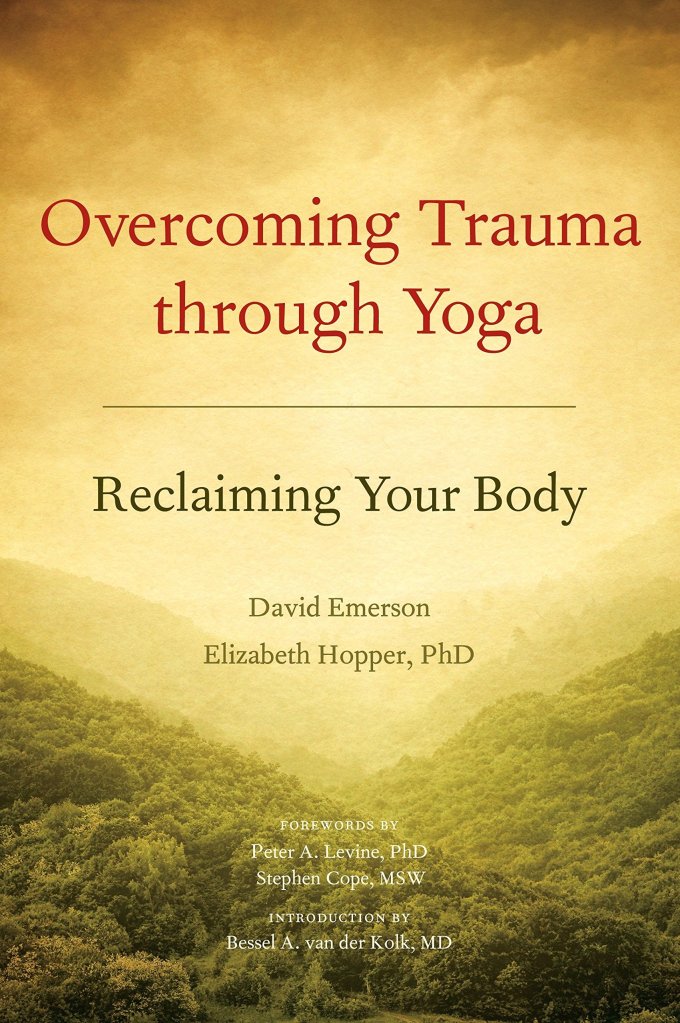
Overcoming Trauma through Yoga.
This book was written by Elizabeth Hopper, a clinical psychologist with more than fourteen years of experience working with survivors. and by David Emerson, a yoga teacher who worked with Dr. Van Der Kolk to create the Trauma Center Yoga Program. The book is ideal for survivors, yoga teachers, and therapists wishing to learn more about Trauma Sensitive Yoga.
One section of the book that stood out to me was about the importance of yoga teachers providing a safe space free of triggers for their students. Additionally, the authors emphasize the importance of appropriate language while guiding survivors in their yoga studios.
Another chapter of the book that I found fascinating was the guide for therapists to use yoga postures with their clients. This section has photos of different yoga postures that can be useful for therapists who want to include them in their sessions with survivors. The authors also explain in detail how to guide the person in becoming aware of their breath and body sensations. In addition, Emerson and Hopper also encourage readers, therapists, and survivors alike to try the postures by themselves at home so they can register how they feel in each posture.
Overall, I think this book is a good option for those hoping to learn more about Trauma yoga. Even though I was uneasy during the first few pages, where the authors discussed the changes in the brains of trauma survivors, in general, it´s an interesting and enjoyable book with plenty of useful information about the power of yoga to help survivors.
When I began my yoga journey in February of 2021, I noticed that a lot of videos on the Internet have the title “Yoga for men” and I didn’t understand the reason. I found different videos about yoga for pregnant women and for elderly, but for some odd reason I didn’t understand why those Yoga teachers wanted to creat videos exclusively for men.
It was not until Yoga became an essential part of my life and I started to share my passion to others that I understood the reason of why those videos were created to encourage men to adopt this healthy style of life.
A lot of men still see yoga as an activity exclusively for women, and some have a prejudice towards men who practice it. In a study in United States, for instance, Thind, Garcia, Velez and Tucker (2021) conducted questionnaires to 79 women and 42 men in the Hispanic community in the northeastern part of United States to know the perception of this community about Yoga.
Not surprisingly, Hispanic men were concerned that Yoga class would have predominantly women practitioners, which could decrease their motivation to attend. Hispanic men were also concerned about unrealistic “pretzel-like poses”, perhaps due to how Yoga is portrayed in the media. Overall, the images of healthy, thin and lean female models practicing Yoga could lead to the perception that Yoga benefits only women (Thing, Garcia, Velez & Tucker, 2020).
Hispanic men in United States are not the only ethnic group with resistance towards yoga. In other Western countries like England (Ding & Stamakis, 2014) Germany (Cramer, 2015) and Australia (Biddle & Vergeer, 2020) Yoga participants were more likely to be female. The reasons why men dislike the idea of practicing yoga might vary from the idea that yoga is for women only, lack of time and/or money, it looks too easy or boring or even due to religious reasons as Yoga is associated with South Indian religious beliefs (Biddle & Vergeer, 2020). Regardless of the reason, it is urgent to encourage more men to practice Yoga due to its benefits for the body and the mind.
The benefits of Yoga.
Yoga is a discipline that every year more scientific research approves its efficiency improving the general wellbeing of people who practice it. The regular practice of Yoga is associated to less alcohol consumption (Cramer, Sibbritt, Park, Adams & Lauche 2017), reduces anger and fatigue (Felver et al, 2014)(6), increases resistance to stress (Ramadoss quoted by Hodzic & Alispahic, 2021) (7), and improves cardiovascular risk factors (Cramer at al,2014) Additionally, the practice of Yoga is associated with the adoption of healthy habits such as better diet, more quality sleep, interest in other physical activities, regular meditation, etc ( Biddle et al, 2021).
Yoga also could improve core symptoms of attention deficit hyperactivity disorder (ADHD) such as inattention, hyperactivity, and impulsivity, in children and adolescents, when practiced as mind-body therapy and form of exercise. In addition, brain scans reported in a different research article, from 2018, also demonstrated that yoga asanas and meditation both reduced amygdala volume on the right-hand side of the brain, which is more associated with negative emotions and fear (Swanson, 2019).
What we can do to encourage more men to adopt this practice?
Knowing all these benefits, we cannot deny that Yoga is a style of life that more men should adopt in order to have a more meaningful life. The question is, how can we encourage more men to practice Yoga? Below are some recommendations that can be effective:
Start your journey online: During the pandemic of Covid-19 a lot of people started to practice Yoga for the first time. For men, this can be a great strategy to get familiar with the postures and create the habit of practice it regularly. This method is also useful for those men who do not have the budget to invest in weekly Yoga lessons, as there are a lot of free options online.
Learn from male Yoga teachers: There is an interesting project in the UK called boysofyoga.com created to share globally the benefits of yoga in men’s physical and mental health. In addition, as I mentioned above, Internet has thousands of male teachers that can make men more comfortable during their first Yoga sessions as a way to understand that Yoga is not a discipline exclusive for women.
Have a famous male role model: From the navy seal David Goggins to the basketball legend Shaquille O’neal. There are a lot of successful and healthy men that have yoga as part of their normal life. Gentlemen can have their famous role models as a strategy to remember that even the toughest guys practice yoga.
Final Thoughts.
As a straight man myself, I love what the practice of yoga has made for my mind and body but at the same time sometimes I feel isolated when I’m surrounded only for women in a yoga class. The recommendations that I wrote above are just a few strategies to encourage more men to incorporate the habit of do yoga in their lives as a way to have physically and mentally healthier individuals in our societies.
However, the best influence that we can make as a men is share without fear that Yoga is an important part of our lives. Something that I’ve learn in the last months with this practice, it’s that a little bit of discomfort is normal in order to discover the secrets of your body by yoga postures. Similarly, sometimes we might feel uncomfortable with some men when we share that we do yoga regularly, but that little discomfort is nothing compare it with the important contribution that we are doing to improve the general wellbeing of men around the world.
References.
Thind, H., Garcia, A., Velez, M., Tucker, .K,L,. (2021) If we offer, will they come: Perceptions of Yoga among Hispanics. Complementary Therapies in Medicine https://doi.org/10.1016/j.ctim.2020.102622
Stamakis, E., Ding, D., (2014) Yoga practice in England 1997-2008: prevalence, temporal trends, and correlates of participation. BMC Res Notes 7, 172. https://doi.org/10.1186/1756-0500-7-172
Cramer, H., Lauche, R., Haller, H., Steckhan, N., Michalsen, A., Dobos, Gustav. (2014) Effects of Yoga on cardiovascular disease risk factors: A systematic review and meta-analysis. International Journey of Cardiology 173(2) DOI 10.1016/j.ijcard.2014.02.017
Vergeer, I., Cagas, J., Biddle, S.J.H. (2020) Yoga not a (physical) culture for men? Understanding the barriers for yoga participation among men. Complementary Therapies in Clinical Practice. DOI 10.1016/j.ctcp.2020.101262
Holger, C., Sibbritt, D., Park, C.L, Adams, J., Lauche, R., (2017) Is the practice of Yoga or meditation associated with a healthy lifestyle? Results of a national cross-sectional survey of 28695 Australian women. Journal of Psychosomatic Research doi: 10.1016/j.psychores.2017.07.013
Felver, J.C., Butzer, B., Olson, K.J, Smith, I,M., Khalsa, S.B,. (2014) Yoga in Public School improves adolescent mood and affect. Contemp School Psycho. DOI 10.1007/s40688-014-0031-9
Alispahic, S., Ajla, H.K. (2021) How does yoga affect health? Yoga teachers experiences. International Scientific Journal of Kinesiology. Sports Science.
Swanson, A. (2019) Science of Yoga. Understand the autonomy and physiology to perfect your practice. Penguin Random House. Canada.




 Sapiens Lara