While these lessons were learned during my time in the military, I can assure you that it matters not whether you ever served a day in uniform. Our struggles in this world are similar, and the lessons to overcome those struggles and move forward will apply equally to all
Those are the words of Admiral William H. McRaven during his speech to almost eight thousand students from the University of Texas in 2014. I chose to start this brief article with those words because every day, more people want to improve their lives and mental health by following the advice of wise military men, and still, there are people who keep asking why a civilian should invest time of their life reading a book wrote it by military veterans?
The answer to that predicament is found precisely in the practical and empowering advice of Admiral William H. McRaven, as shared in his engaging book “Make Your Bed.” This book, which I highly recommend, offers a straightforward approach to adopting healthy and necessary habits that can significantly improve our lives on this planet. It’s not just theory, but practical steps that you can take to improve your life. Because of the high popularity of videos on the Internet and literature about self-improvement, many authors encourage people to make their bed as their first task to complete at the beginning of their daily routines. Admiral McRaven explains the benefits of completing this task in his book. I also found other valuable lessons that harmonize with contemporary psychology to find a more meaningful life with ourselves and the rest of the world.
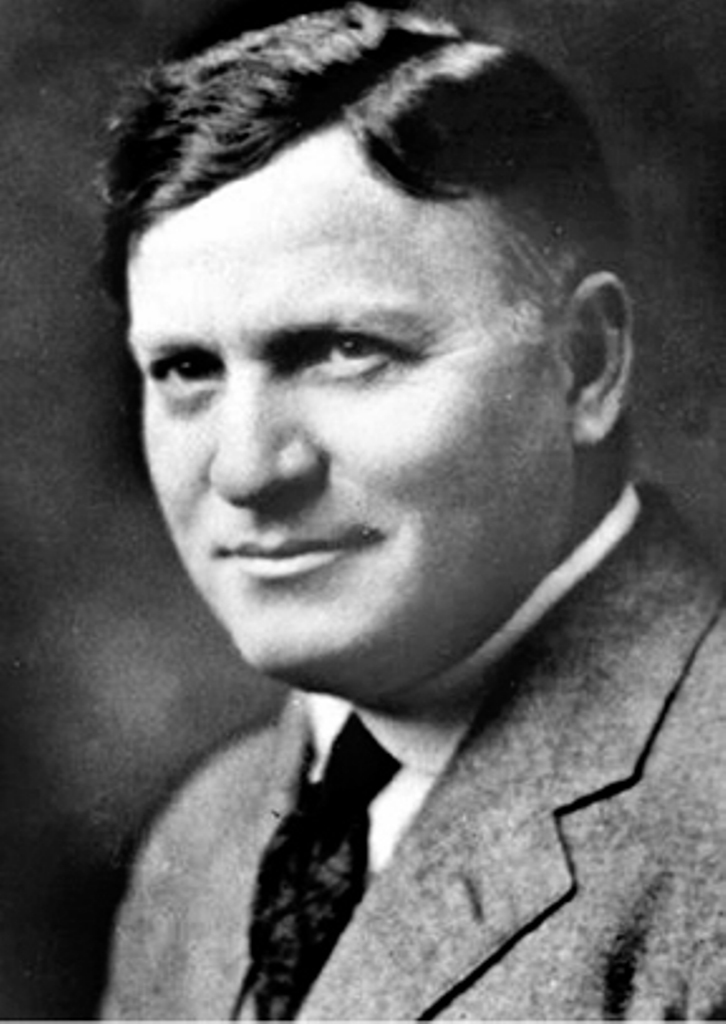
Admiral William McRaven. Photo by The University of Texas at Austin
For example, the author mentions the importance of creating purposeful relationships with other humans. This is an important lesson to remember, as we cannot deny the incredibly high sociability of our species. I also found different lessons that resonate with the concept of Antifragility (a property of systems in which they increase in capability to thrive due to stressors) developed by the author Nassim Nicholas Taleb. Although Admiral McRaven did not mention this concept at all, he gave us exciting examples that remind us that most of the time, we must accept feeling uncomfortable to achieve our aims. It was also emotional and meaningful to read the different stories of brave people he met during his military career. They are perfect examples of how life can throw us the most horrible tragedies, but we decide what kind of attitude we will adopt to face the different calamities we can find as human beings.
To conclude, “Make Your Bed” is a highly recommended book to anyone who wants to enjoy a light but profound reading about the lessons of a man built in the US Navy, but with a wise perspective about the human condition that can be applied to any person who wants to create a better life for themselves, and why not, to create a better world for everybody.
When I began my yoga journey in February of 2021, I noticed that a lot of videos on the Internet have the title “Yoga for men” and I didn’t understand the reason. I found different videos about yoga for pregnant women and for elderly, but for some odd reason I didn’t understand why those Yoga teachers wanted to creat videos exclusively for men.
It was not until Yoga became an essential part of my life and I started to share my passion to others that I understood the reason of why those videos were created to encourage men to adopt this healthy style of life.
A lot of men still see yoga as an activity exclusively for women, and some have a prejudice towards men who practice it. In a study in United States, for instance, Thind, Garcia, Velez and Tucker (2021) conducted questionnaires to 79 women and 42 men in the Hispanic community in the northeastern part of United States to know the perception of this community about Yoga.
Not surprisingly, Hispanic men were concerned that Yoga class would have predominantly women practitioners, which could decrease their motivation to attend. Hispanic men were also concerned about unrealistic “pretzel-like poses”, perhaps due to how Yoga is portrayed in the media. Overall, the images of healthy, thin and lean female models practicing Yoga could lead to the perception that Yoga benefits only women (Thing, Garcia, Velez & Tucker, 2020).
Hispanic men in United States are not the only ethnic group with resistance towards yoga. In other Western countries like England (Ding & Stamakis, 2014) Germany (Cramer, 2015) and Australia (Biddle & Vergeer, 2020) Yoga participants were more likely to be female. The reasons why men dislike the idea of practicing yoga might vary from the idea that yoga is for women only, lack of time and/or money, it looks too easy or boring or even due to religious reasons as Yoga is associated with South Indian religious beliefs (Biddle & Vergeer, 2020). Regardless of the reason, it is urgent to encourage more men to practice Yoga due to its benefits for the body and the mind.
The benefits of Yoga.
Yoga is a discipline that every year more scientific research approves its efficiency improving the general wellbeing of people who practice it. The regular practice of Yoga is associated to less alcohol consumption (Cramer, Sibbritt, Park, Adams & Lauche 2017), reduces anger and fatigue (Felver et al, 2014)(6), increases resistance to stress (Ramadoss quoted by Hodzic & Alispahic, 2021) (7), and improves cardiovascular risk factors (Cramer at al,2014) Additionally, the practice of Yoga is associated with the adoption of healthy habits such as better diet, more quality sleep, interest in other physical activities, regular meditation, etc ( Biddle et al, 2021).
Yoga also could improve core symptoms of attention deficit hyperactivity disorder (ADHD) such as inattention, hyperactivity, and impulsivity, in children and adolescents, when practiced as mind-body therapy and form of exercise. In addition, brain scans reported in a different research article, from 2018, also demonstrated that yoga asanas and meditation both reduced amygdala volume on the right-hand side of the brain, which is more associated with negative emotions and fear (Swanson, 2019).
What we can do to encourage more men to adopt this practice?
Knowing all these benefits, we cannot deny that Yoga is a style of life that more men should adopt in order to have a more meaningful life. The question is, how can we encourage more men to practice Yoga? Below are some recommendations that can be effective:
Start your journey online: During the pandemic of Covid-19 a lot of people started to practice Yoga for the first time. For men, this can be a great strategy to get familiar with the postures and create the habit of practice it regularly. This method is also useful for those men who do not have the budget to invest in weekly Yoga lessons, as there are a lot of free options online.
Learn from male Yoga teachers: There is an interesting project in the UK called boysofyoga.com created to share globally the benefits of yoga in men’s physical and mental health. In addition, as I mentioned above, Internet has thousands of male teachers that can make men more comfortable during their first Yoga sessions as a way to understand that Yoga is not a discipline exclusive for women.
Have a famous male role model: From the navy seal David Goggins to the basketball legend Shaquille O’neal. There are a lot of successful and healthy men that have yoga as part of their normal life. Gentlemen can have their famous role models as a strategy to remember that even the toughest guys practice yoga.
Final Thoughts.
As a straight man myself, I love what the practice of yoga has made for my mind and body but at the same time sometimes I feel isolated when I’m surrounded only for women in a yoga class. The recommendations that I wrote above are just a few strategies to encourage more men to incorporate the habit of do yoga in their lives as a way to have physically and mentally healthier individuals in our societies.
However, the best influence that we can make as a men is share without fear that Yoga is an important part of our lives. Something that I’ve learn in the last months with this practice, it’s that a little bit of discomfort is normal in order to discover the secrets of your body by yoga postures. Similarly, sometimes we might feel uncomfortable with some men when we share that we do yoga regularly, but that little discomfort is nothing compare it with the important contribution that we are doing to improve the general wellbeing of men around the world.
References.
Thind, H., Garcia, A., Velez, M., Tucker, .K,L,. (2021) If we offer, will they come: Perceptions of Yoga among Hispanics. Complementary Therapies in Medicine https://doi.org/10.1016/j.ctim.2020.102622
Stamakis, E., Ding, D., (2014) Yoga practice in England 1997-2008: prevalence, temporal trends, and correlates of participation. BMC Res Notes 7, 172. https://doi.org/10.1186/1756-0500-7-172
Cramer, H., Lauche, R., Haller, H., Steckhan, N., Michalsen, A., Dobos, Gustav. (2014) Effects of Yoga on cardiovascular disease risk factors: A systematic review and meta-analysis. International Journey of Cardiology 173(2) DOI 10.1016/j.ijcard.2014.02.017
Vergeer, I., Cagas, J., Biddle, S.J.H. (2020) Yoga not a (physical) culture for men? Understanding the barriers for yoga participation among men. Complementary Therapies in Clinical Practice. DOI 10.1016/j.ctcp.2020.101262
Holger, C., Sibbritt, D., Park, C.L, Adams, J., Lauche, R., (2017) Is the practice of Yoga or meditation associated with a healthy lifestyle? Results of a national cross-sectional survey of 28695 Australian women. Journal of Psychosomatic Research doi: 10.1016/j.psychores.2017.07.013
Felver, J.C., Butzer, B., Olson, K.J, Smith, I,M., Khalsa, S.B,. (2014) Yoga in Public School improves adolescent mood and affect. Contemp School Psycho. DOI 10.1007/s40688-014-0031-9
Alispahic, S., Ajla, H.K. (2021) How does yoga affect health? Yoga teachers experiences. International Scientific Journal of Kinesiology. Sports Science.
Swanson, A. (2019) Science of Yoga. Understand the autonomy and physiology to perfect your practice. Penguin Random House. Canada.
It is not unusual that some therapists recommend books, essays, even podcasts to help their patients in their process of healing. Poetry in particular, it is another powerful tool that can help people to know more about themselves and life in general.
Max Ehrmann, author of “Desiderata”
“Desiderata”, which means “things desired’ is an early 1920s prose poem by the writer Max Ehrmann that can teach people about the reality of the world and also has a powerful message that can help us to live in peace with all the creatures of our environment. These are the main reasons of why you should read every day the poem “Desiderata” to improve your mental wellbeing:
You will remember to be on good terms with everyone.
The poem is a reminder that although we are divided by religion, nationalities, and languages we are in essence part of the same species originated in Africa. Therefore, we should try be in peace with every person that we find in our path without forget that we must be treated with dignity and respect as well.
Everyone has something to teach you.
There is one stanza that will remind you that you have the right to express your opinion but also that you must be intellectually brave to listen others’ point of view. Also, that you need to remember that wisdom it is not something exclusive of professors or researchers in Universities, but you can learn also from those without academic education but with a lot of experience in life.
Don’t compare yourself with others.
The constant stimuli from social media had provoked that contemporary Psychologists constantly encourage people to concentrate in their lives only. “Desiderata” will provide you a beautiful advice of how it is important to not compare your life with other humans but to focus all your attention in your aims and existence.
There is still virtuous people out there.
You will also learn in the poem that it is understandable to be cautious during your normal life, as there are a lot of malicious people who intentionally will hurt you. Nevertheless, do not generalize, because there are a lot of wonderful Sapiens making the world a better place and certainly you can join them and promote love instead of hate.
Remember, you are a child of the universe.
Think about this, you are a brilliant animal with particles in your cells that had existed for millions of years (Sundermier, 2015). The atoms of your body were made in fusion reactions in stars (McMahon, n/d). “Desiderata” will remind you everyday day that you are not so different than other animals or the trees and plants in your surroundings. The poem will be a daily reminder that you need to go outside to seek harmony with your environment, and go inside (by metidation and introspection) to find harmony with yourself.
Do not forget that it is still a beautiful world.
The final stanza will invite you to accept that there are a lot of cruelty and chaos in the world. Nonetheless, you need to be grateful, you need to enjoy the beauty of the simple things in life, because at the end, our planet is still a wonderful place in the universe.
To conclude, I invite you to read the poem, analyze it and feel whatever you need to feel. Joy, anger, sorrow, “Desiderata” is a wise poem that can provoke different emotions, enjoy them, learn from them and I hope you can make this poem a daily or at least a weekly reading so you can enjoy with intensity and wisdom the gift of life.
“Napoleon” is a 1995 film about a Golden Retriever who decided to escape its comfortable life in Sydney, to search dingoes in the Australian forests and become a wild dog. Although it’s a movie for kids, the plot is full of interesting allegories about human life that adults can find fascinating.
In this article, we are going to explore the wonderful message that the writers Mario Andreacchio, Michael Bourchier and Mark Saltzman gave us in the film. The article is full of spoilers, so stop reading if you want to watch the movie first. You can find the film here:
The film begins with a golden retriever puppy named “Muffin” living with a human family and his mum in Sydney, Australia. The puppy is calling himself “Napoleon” as the French emperor due to his wishes to demonstrate that he’s strong and brave. Napoleon wants to escape his comfortable life and live with the wild dogs that he can hear howling at the distance.
The wild dogs howling is a clear allegory of Napoleon’s wild ancestors (Hunter-Gatherers for Humans). Napoleon is a domesticated dog but the howling is a reminder that in essence he is a wild dog, as most researchers in canine genetics agree that dogs are domesticated wolves. (Morris Animal Foundation, 2020). And at the same time, it’s an indirect invitation to reunite with his wild cousins.
Our life as species changed since we adopted agriculture (Harari, 2014), and for us the “howling” of our hunter-gatherer ancestors is clear when we want to go capping, running, practice collective sports, do yoga, hiking, being lazy in the beach, have passionate sex or even escape civilization and live in a cottage or build your own log in the forest.
True, not everyone wants to go and live in the mountains or jungles. However, that “howling” appears every time that our body needs a pause from our domesticated life to get back to our wilderness, to get back to nature, to our organic reality.
The mentor.
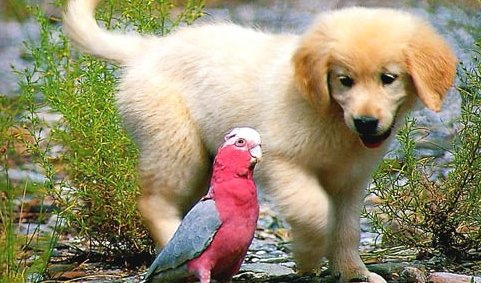
Napoleon escaped and arrived to the forest by a basket with balloons that his human family left unsupervised during a birthday party. Once in the bush, he meets a galah (pink cockatoo) named “Birdo”, who became his mentor. Birdo argues that the forest it’s not a safe place for a domestic puppy and insists that Napoleon must return home. Napoleon, following his young and stubborn temperament, decides to stay and find the wild dogs.
He convinces Birdo to teach him the basic things to survive in the wild. The bird tries to teach him to hunt his prey but Napoleon fails as he doesn’t accept the reality that he needs to kill another creature in order to survive. At the end, the puppy ends eating moss from a rock becoming a type of “vegan” dog.
Birdo is a clear symbol of the different people that we meet in our life teaching us something. Could be your parents, a teacher, a counselor, a sport coach, martial arts sensei or a person from the internet. In addition, the interaction between this feathered mentor and his furry protégé teach us another important lesson about this type of relationship.
In one scene, Birdo disagrees with Napoleon’s intentions to continue his search for the wild dogs. “You don’t understand. You’re a bird, I’m a dog, this is a dogs thing” said Napoleon. The scene concludes with Napoleon saying good bye to Birdo and continue his path in solitude.
The message from this scene is to accept that at one point in our life, we’re going to conclude our relationship with our mentors. And that is a completely natural situation in the life of any human. Maybe you disagree with your mentors about different things and you don’t think they will help you more in your projects. Be grateful, let them go and follow your path.
Facing your fears.
While Napoleon is resting between some bushes , a torrential rainstorm arrives. Napoleon runs for sheltered and found two dingo pups inside a cave. The dogs start barking at him as they think he is a predator.
Napoleon emphasizes that he won’t hurt them. Suddenly, the water floods the cave and sweep one of the pups away. The other dingo is not strong enough to rescue its sister, so Napoleon doesn’t have a choice but to dives in and rescue her. After some dramatic moments, he rescued the pup and the storm ends. Then, Napoleon sees a big dog in the entrance of the cave, “That’s our mum!” one of the dogs said, Napoleon found a wonderful surprise, finally he has found the wild dogs!
There are different circumstances in life when you need to face your fears. I know, it sounds cliché, but it’s true. Hopefully, you will not be in a situation like Napoleon’s where you need to save another creature. However, everyday there are things in life that you know are good for you but you’re afraid to do. Fear will be there, it’s a natural response from our bodies but you need to remember that you are a strong ape, capable to do incredible things. So, feel the fear and do it anyway! (Jeffers, 2012).
The deep analysis.
The dingo mother agrees to let him live with them, as a way of reward for saving her cubs. One morning, the mother and Napoleon went out for a walk. She starts asking about his life , his mother and why he ran away from home. He answers that he wanted to become wild, so he can be very brave and fearless. The Dingo wisely responds:
“But, you have been that all along. You couldn’t had come this far without being fearless. And it was your bravery that saved Cid and Nancy. In your heart, you have been a wild dog all along, Napoleon”
Due to our domesticated life, we forget how hard and strong we are. Our hunter-gatherer ancestors resisted and faced different dangers and survived. Just as wild dogs live in Napoleon’s heart, humans need to remember that we are strong primates, descendants of vigorous and brave hunter-gatherers ancestors.
Napoleon, accepted his wild essence and discovered his inner power. He understood that he was brave and strong due to facing his fears and helping others. After the conversation with the Dingo, he decided to return home.
Returning to “the mother”.
Napoleon reached the coast by the help of a kangaroo, acquaintance of the dingo mother. Once there, Birdo reappears with a sea turtle who takes Napoleon back to Sydney. He reencounter his mother whom consents to calling him Napoleon instead of Muffin, as a way to recognize that her puppy is an adult.
The symbolism that I found here is not only to remember that it doesn’t matter how old you are, if you still have your parents, it’s completely benign to find guidance from them when things in your life are not good. But also, it’s a way to remember that we are organic creatures and we can accept our animal reality and return to mother nature every time that we are exhausted from civilization.
Returning to mother nature means that if you are feeling exhausted from your work or study, stop, and have a good sleep. If you are eating a lot of junk food, stop, and have fruits and veggies. If you are drinking a lot of soft drinks, stop, and have more water. If you’re feeling drained, stop, and do some meditation. If you’re feeling lonely, talk with people you love. Remember, you’re part of the nature, before go outside to “hug trees” start with taking care of yourself!
When Napoleon was returning to the coast after his encounter with the dingoes, he adopted a new title “Napoleon, the wild house pet” , as a way to accept that he is domesticated but he is still capable to be wild. For humans, returning to the mother means that you can continue living in the civilized world but you have the capacity to reconnect with your animal reality when you need a break.
A great movie for kids and adults!
To conclude, “Napoleon” is a great film to show kids the beauty of the Australian fauna and parents can explain to their children the messages from Napoleon’s adventure and how these are related to our life as a humans. Without mention that the scenery of Australian landscapes make this movie extremely enjoyable to watch.
References.
Andreacchio, M (Director) (1995) Napoleon [Film] Roger Dowling.
Harari, Y. N. (2014) Sapiens. A brief history of humankind. Penguin Random House.
Jeffers, S. (2012) Feel the fear and do it anyway. Vermillon.
David Goggins is a retired Navy Seal and endurance athlete who has competed in more than sixty ultra-marathons. He is one of the best examples of antifragility and how important it is to control the power of our minds. He grew up with an alcoholic and violent father, kids at school used to write racist insults in his Spanish book, he was diagnosed with ADHD and had learning difficulties due to the toxic stress he was suffering. During his early twenties, he was a depressive overweight man with a job cleaning restaurants’ kitchens from cockroaches (Goggins, 2018).
Everything changed when Goggins watched a Discovery Channel documentary called “Class 224” about the intense training of the SEAL candidates. That documentary made him reflect about his own fears and insecurities by watching those men overcoming adversity during that extreme physical and mental training. It was in that moment that Goggins decided to be a Navy SEAL. His journey was not easy. It was full of obstacles, defeats and tragedies, but at the end he achieved his goals and conquered his fears (Rogan, 2018).
From his book”Can’t hurt me” and his appearances in different podcasts, David Goggins is inspiring people from different backgrounds and ages to callous their minds and seek the life they want. Here are some reasons of why David Goggins’ message is so powerful and what we can learn from him.
He is not affraid to share the wounds from his past.
David Goggins is not afraid to share all the awful things that he suffered during his life. Not only because those episodes helped him to calloused his mind and work harder, but also is way to show his humanity. When he shows the scars from his past, people can see that his life was not perfect, that he was not privileged and that he had to conquered his fears. Showing his humanity allows people to accept their own wounds, their own mistakes, insecurities, fears and start fighting for the life they want.
The challenges from his book will make you growth..and maybe cry.
If you get his book “Can’t hurt me”, you will find challenges after each chapter. Goggins will give you challenges that will make you feel uncomfortable and confront your inner fears. These challenges will be beneficial for you as you will accept the mistakes and defeats from your past, identify what you want to achieve and what things you need to do in order to achieve your aims.
The challenges will make you feel uncomfortable, and yes, maybe you will cry (because it is not easy to confront the painful memories from your past and the fears for your future), but that might precisely what you need to train your mind to face with efficiency and bravery the real challenges in your life.
David Goggins photo by xterraphotos.
Do something that sucks every day.
Every day, you must do something that you hate that you know is good for you. Most people hate cold showers but they do it anyway because it helps their bodies and brains to feel better. Most people dislike do the dishes and clean their houses, but they do it because it is good for your health to keep your place clean and tidy.
You need to suffer a little bit with activities that you hate but are good for you so you can train your brain to keep going and do not quit when things are getting complicated in different life circumstances. The more often you get uncomfortable the stronger you will become and soon you will develop a more productive, can-do dialogue with yourself in stressful situations (Goggins, 2018).
The cookie jar, don’t forget how hard you are!
The cookie jar is a concept created by Goggins as a way to remember our past victories. This strategy is to remember the little victories from your past when you are facing challenging moments and your mind wants to quit. This is a powerful concept because you are remembering triumphs from your own life, at the end this is a personal battle.
Next time that you are training or in a sport competition, studying for a test, working in a project that you need to present to your boss and you start to feel fragile, weak and want to stop. Remember the victories from your past. It doesn’t have to be a big victory either. It can be something small, but when the pain and tiredness hits and tries to stop you short of your goal, dunk your fist in, pull out a cookie, and let it fuel you (Goggins, 2018).
Final thoughts.
There are a lot of things that I want to write about David Goggins but I think you should grab his book and start your own journey of self improvement according to his teachings. There are not magical formulas in his book. It is just pure evidence of a Homo Sapiens that grew up in a hostile environment and instead of playing the victim card, decided to accept the pain of the existence and control the most powerful tool in life, our own mind!
U.S. Navy Seal (ret.) David Goggins courtesey photos.
Goggins, D. (2018) Can’t hurt me. Lioncrest Publishing. Bolton, ON
Morning Run. Retired Navy Chief Petty Officer and former Navy SEAL David Goggins poses for a photo before his morning run, a habit he has formed over his years of training and almost never misses. [Photograph] By David Goggins courtesey photos. US Department of Defense. https://www.defense.gov/observe/photo-gallery/igphoto/2002070205/
Today, we celebrate the 132th anniversary of the birth of the Russian psychologist and ethologist Nadezhda Nikolaevna Ladygina-Kohts. She was a pioneer in the study of nonhuman animal mind and her investigations demonstrated that cognition and empathy are non exclusively humans and she provided a method that is still in use in contemporary Psychology. This is her story:
Nadezhda Ladygina-Kohts was born in Penza, Russia, on May 18, 1889. Her father was a music teacher and her mum did not have any formal education (Seel, 2012). She finished her study of comparative Psychology at Moscow University in 1917 and became head of the Laboratory of Zoopsychology of the Darwin Museum, which had been founded by her husband, the Russian zoologist Alexander F. Kohts ( Van Rosmalen et, al. 2011).
There, she studied the behaviour of monkeys and apes and published her findings in Russian, German and French. However, it was not until 2002 that her book “Infant Chimpanzee and Human Child” edited by Primatologist and professor in Psychology from Emory University, Frans de Waal, was translated to English.
The chimpanzee Joni.
Ladygina-Kohts most famous feat was to raise the baby chimpanzee named Joni for years and compare the observations of his behaviour with those of her own son Rudi. These observations were published in the book “The chimpanzee child and the human child: their instincts, emotions, play habits and expressive movements”
One of the most important things that Ladygina-Kohts discovered during her observations with Joni was the existence of empathy without language. Every day, Ladygina-Kohts had to deal with his unruly behaviour. She found out that the only way to get Joni off the roof of her house was to appeal to his concern for her. In her book, Infant Chimpanzee and Human child, she wrote:
“If I pretend to be crying, close my eyes, and weep, Yoni immediately stops his plays or any other activities, quickly runs over to me, all excited and shagged, from the most remote places in the house, such as the roof or the ceiling of his cage, from where I could not drive him down despite my persistent calls and entreaties. He hastily runs around me, as if looking for the offender, looking at my face, he tenderly takes my chin in his palm, lightly touches my face with his finger, as though trying to understand what is happening” (De Waal, 2005, p.184).
In these photos, we can see different reactions of Joni towards Ladygina-Kohts’ emotions. Photos shared by Alexey Merkuryevich Gilyarov.
Ladygina-Kohts discovered that we do not need words or complex language in order to feel empathy for someone. A knowledge that is highly used among professionals in Ethology and Psychology nowadays.
Match-to-Sample Paradigm.
Nadia and Joni during one experiement. Darwin Museum Fund.
According to American psychologist Robert Yerkes, there is a good chance that Ladygina-Kohts invented the matching-to-sample (MTS) paradigm, which is widely used nowadays to help people with Autism Spectrum Disorder (De Waal, 2016).
Nadia (diminutive of Nadezhda) would hold up an object for Joni, then hide it among other objects in a sack and let him feel around to find the first one. The test involved two modalities, vision and touch, demanding that Joni make a choice based on his memory of the previously seen model (De Waal, p.97 2016).Interestingly, Ladygina’s studies were not limited to primates but also studied parrots.
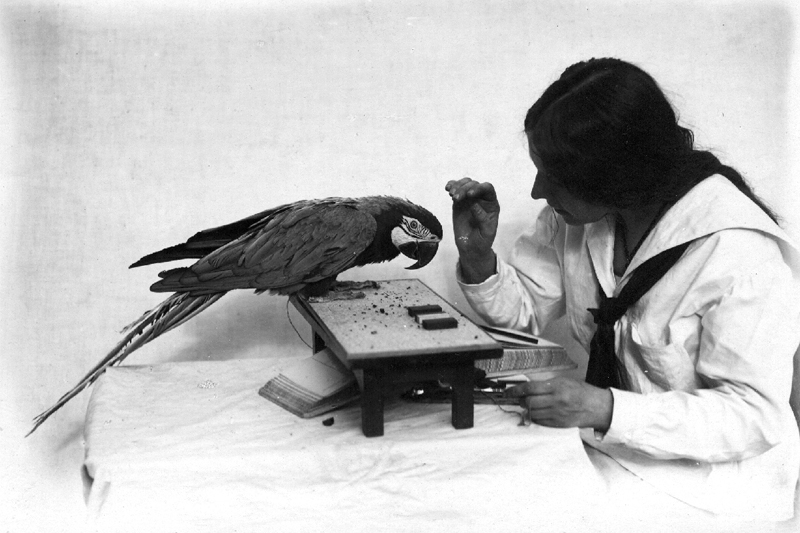
In the photo below, which is part of the photographs at the Darwin Museum, we can see Nadia working with a macaw. The parrot sits opposite her on the table, while Ladygina-Kohts held a small food reward in one hand and a pencil in the other, scoring its choices as she tested its ability to discriminate among objects.
Ladygina-Koths working with a macaw. Photo shared by Olga Romanovna.
A smart strategy against the Lysenkoism.
Nadia with her husband, the zoologist Aleksandr Kohts.
Ladygina-Kohts is also a great example of bravery. Because her experiments and her work at Darwin Museum with her husband, they were considered dangerous against the ideas of the most powerful Soviet politicians. Under the influence of the would-be geneticist Trofim Lysenko (strong proponent of Lamarckism and author of pseudoscientific ideas termed Lysenkoism), Joseph Stalin had many a brilliant Russian biologist either shot or sent to the Gulag for thinking the wrong thoughts.
Lysenko believed that plants and animals pass on traits gained during their lifetime. The names of those who disagreed with him became unmentionable, and entire research institutes were closed down. Lysenko was distinctly ambivalent about Darwin’s theory, some of which he labeled “reactionary”. To stay away of trouble, Nadia and her husband hid documents and data among their taxidermy collection in the museum basement. Then, wisely put a large statue of the French biologist Jean Baptiste Lamarck at the museum entrance (De Waal, 2016).
Let’s not forget her legacy.
The Kohts Family. Aleksandr and Nadia with their son, Rudy.
Nadezhda Ladygina-Kohts was a pioneer of evolutionary cognition, is much beloved in her country and is widely recognized as the great scientist that she was (De Waal, 2016). However, a lot of people in Western nations studying Psychology still ignore her life and scientific contributions. Was Ladygina-Kohts overlooked by science due to her gender? Or was it her language? Or political censorship?
Frans de Waal, learnt about her by Robert Yerkes’ books, and I learnt about her by de Waal’s literature. I am not comparing myself with these two legends in Psychology and Primatology, but as an interesting fact, Nadezhda is a Slavic name which means “Hope”. Therefore, regardless of the reasons why her name is not well known in most Western faculties of Psychology, I hope with this article I can stimulate the curiosity of readers so they can learn more about the contributions of Ladygina-Kohts and give her the recognition that she deserves as a brave and brilliant scientist.
References.
De Waal, F. (2016). Are we smart enough to know how smart animals are?. W.W. Norton & Company.
Penza Oceanarium (2019). ФЛЭШМОБ К 130-ЛЕТНЕМУ ЮБИЛЕЮ НАДЕЖДЫ НИКОЛАЕВНЫ ЛАДЫГИНОЙ-КОТС. (Flashmob to the 130th anniversary of Nadezhda Ladygina-Kohts) http://oceanpenza.ru/2019/05/12/513/
Seel, M. (2012). Encyclopedia of the sciences of learning. Springer US Publishing.
Timofeev, D. (2016, January 10) Опыты с шимпанзе, работы Надежды Николаевны Ладыгиной-Котс (Experiments with chimpanzees, works by Nadezhda Ladygina-Kohts) [YouTube Video] https://www.youtube.com/watch?v=RKPuotJLvEo
Van Rosmelen, L., Van der Horst, F,. Van der Veer, R. (2011). An unexpected admirer of Ladygina-Kohts. History of Psychology, Vol.14. American Psychological Association.
The contributions to Psychology from scientific fields such as Primatology are fundamental to understand more about our behaviour as human beings. Aggressiveness, mating, sexual promiscuity and social hierarchies are the most popular topics for students and professionals in Psychology interested in learn from Primatology.
However, every day we do other common activities that are usual as well in bonobos and chimpanzees. In this article, we are going to study the investigations of the primatologist Frans De Waal and discover some similarities that we share with other primates and how close we are with them.
French Kiss or Bonobo Kiss?
The French kiss is normal in humans during sexual intercourse and to show desire, trust and love for a partner. This form of kiss is common in other primates too, such as chimpanzees and bonobos. In fact, the French Kiss is the bonobo’s most recognizable, humanlike erotic act.
Whereas for chimpanzees a kiss is friendly rather than sexual. The tongue kiss is an act of total trust: the tongue is one of our most sensitive organs, and the mouth is the body cavity that can do it the quickest harm. The act permits us to savor another. But at the same time we exchange saliva, bacteria, viruses and food.(De Waal, 2005, p.90).
Bonobos kissing.
Personal Grooming.
You take a shower, put your clothes on, maybe some make up and perfume. Before leave the house, you need to fix your husband’s tie and your kids’ hair. Now everybody is ready to attend your cousin’s wedding! Grooming is a normal activity for humans and an expression of love for ourselves and our beloved ones, and with other primates is not different.
Just as De Waal said “Grooming is the social cement of any primate society” and humans are not the exception. Perhaps we don’t spend hours cleaning the head of our children or friends as chimpanzees do but the simple act of grooming is another daily activity that we share with other primates.
Sharing food.
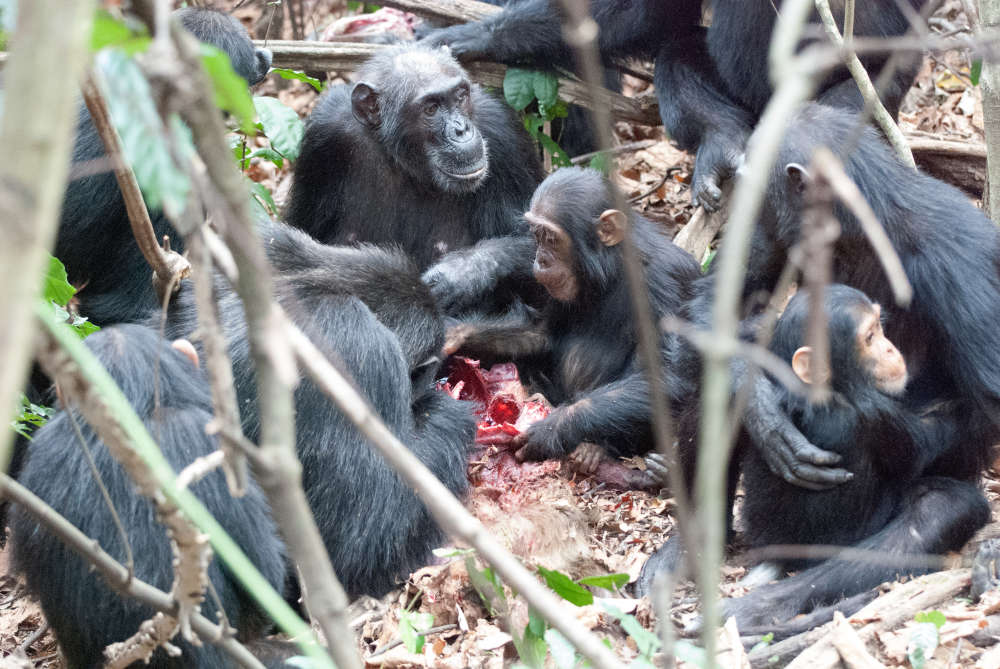
We share turkey in Thanksgiving day and Christmas, we do BBQs to share burgers and steak with our friends and some cultures sacrifice a lamb for special occasions like weddings. These activities are not exclusively human as share food, meat in particular, is also pretty common among chimpanzees and capuchin monkeys. (De Waal, 2005, p.206).
A group of Chimps sharing a meal.
In the wild, these primates chase monkeys until they capture one and they tear it apart so that everyone gets a piece. Interestingly, food sharing is also possible with vegetarian meals. Frans De Waal observed that when he and his team fed chimpanzees at the zoo, normally watermelons or a tight bundle of branches with leaves, the primates burst out in a celebration during which they kiss and embrace each other.
So the next time that you are sharing food with your loved ones, have in mind that you are doing an activity that is normal for these primates and also is a heritage from our ancestors who were experts on hunting.
Reconciliation.
According to Cambridge Dictionary, reconciliation is a situation in which two people or groups of people become friendly again after they have argued (Cambridge, n/d). Humans are not the only creatures capable of this action, as every year are more proofs that reconciliation exist also in other primates. Frans de Waal has a fascinating story about an example of reconciliation between chimpanzees:
I’ll never forget one particular winter day at the Arnhem Zoo (Netherlands). The entire chimpanzee colony was locked indoors, out of the cold. In the course of a charging display, I watched the alpha male attack a female, which caused great commotion as other apes came to her defense. The group calmed down, but an unusual silence followed, as if everyone was waiting for something. It lasted a couple of minutes. Then, unexpectedly, the entire colony burst out hooting, and one male rhythmically stamped on the meal drums stacked in the corner of the hall. In the midst of all the pandemonium, at the center of attention, two chimps kissed and embraced. I reflected on this sequence for hours before I realized that the two embracing apes had been the male and female from the original row (De Waal, 2005, p 150).
There is something important to remember, just as chimpanzees, bonobos and capuchin monkeys, humans are social primates, hence social interactions are fundamental to our species. That is the reason why reconciliation for these primates is really important to maintain peace within the group. We always believed that reconciliation was an authentic human action but now we know that is a normal strategy to resolve conflict among other primates too.
Empathy.
Comparative psychologist Nadezhda Ladygina-Kohts with Yoni, 1914.
This is connected and necessary for reconciliation. The Russian psychologist Nadezhda Ladygina-Kohts who raised a young chimpanzee named Yoni during the early-twentieth century, discovered the existence of empathy in Yoni when she realised that the only way to get him off the roof of her house was to appeal to his concern for her:
“If I pretend to be crying, close my eyes, and weep, Yoni immediately stops his plays or any other activities, quickly runs over to me, all excited and shagged, from the most remote places in the house, such as the roof or the ceiling of his cage, from where I could not drive him down despite my persistent calls and entreaties. He hastily runs around me, as if looking for the offender, looking at my face, he tenderly takes my chin in his palm, lightly touches my face with his finger, as though trying to understand what is happening” (De Waal, 2005, p.184).
Basically, empathy is the ability to be affected by the state of another individual or creature. One of the reasons that a lot of scientists considered empathy as an exclusive human skill was because was assumed that empathy requires language. However, Carolyn Zahn-Waxler, who is one of the pioneers of empathy research in children, had discovered that empathy develops well before language. This is relevant for animal research and to understand that other mammals are capable to feel empathy as well.
For instance, Carolyn’s research team discovered that household pets, like dogs or cats, were as upset as children by distress-faking family members. The animals hovered over them, putting their heads in their laps with what looked like concern. Judge by the same standard as the children, the pets exhibited empathy as well. Such behaviour is even more striking in apes, specifically chimps. De Waal argues that it’s not unusual for a climbing youngster to fall out of a tree and scream. It will immediately be surrounded by others who hold and cradle it. In addition, if an adult chimpanzee loses a fight with a rival and sits screaming alone in a tree, others will climb toward him to touch and calm him (De Waal, 2005, p.183).
Therefore, the investigations of Ladygina-Kohts, Zahn-Waxler and De Waal, make us understand that spoken language is not necessary to have empathy. Just ask parents how they feel when they hear their babies crying. They do not know how to articulate words yet, but their weeping is enough to make adults empathize with infant’s distress. Additionally, adults can feel empathy for someone without hearing words too. A man feels worry when he hears his girlfriend sobbing and vice vice versa.
Although it’s not a real situation, but we can observe an useful example of empathy without spoken language between humans on the episode “Back from Vacation” from the famous American sitcom “The Office US”. At the minute 14:53, the secretary Pam Beesly is crying alone in the halls of the building where she works. Suddenly, the salesman Dwight Schrute, who has a cold but strong personality, finds her co-worker sobbing painfully after she witnessed Jim Halpert and his girlfriend Karen make up after a fight.
Who did this to you? asked Dwight, even thought Pam did not say a word, Dwight knew that something was wrong and felt empathy for her, because her tears were enough to communicate her sorrow. The scene concludes with Dwight putting his hand gently on Pam’s shoulder while she continues crying (The Office, 2007).
Dwight consoling his co-worker Pam. The Office US, S3 E11.
The most interesting thing about this scene is that a human being (Dwight) felt empathy to see another person crying and he tries to comfort her even when he does not know the reason of Pam’s sadness. The wonderful use of this information is not only to finally accept that humans, primates and other animals can feel empathy without the use of words, but also to embrace that human beings do not need to speak the same language in order to show empathy towards others.
Conclusion.
Maybe is unfair to write in the same article about obvious animalistic actions like kissing, eating and grooming with something more complex like reconciliation and empathy. Nevertheless, this article’s intention is to show the reader our similarities with other primates not only to embrace our animal reality but also to remember that we are able to connect positively with other humans regardless our race and language.
And at the same time, that we need to continue investigating even deeper to understand more our behaviour and our evolutionary connection with the rest of animal kingdom to improve our relationship with the natural world. I highly recommend the book “Our Inner Ape” by the leading primatologist Frans De Waal to know more about this topic.
Nadezhda Ladygina-Kohts and the chimpanzee Joni, [Photograph] 1914. Official Portal of the Moscow Mayor and Moscow Government. https://www.mos.ru/en/news/item/74118073/
Farino, J (Director) Spitzer, J (Writer). (2007, April 1) Back from Vacation. (Season 3, Episode 11) [The Office US Episode] In Silverman, B. Daniels, G. Gervais, R. Merchant, S. Klein, H. Lieberstein, P. Celotta, J. Schur, M. Zbornak, K. (Producers) NBC Universal.
In the past, some psychologists saw fantasies as something negative. Something that all patients should avoid in order to have a balanced life. However, today we know that fantasies could be beneficial for your mental health as long as you know that you are fantasizing. This sounds complex but it’s easy to understand. Fantasies (not only sexual but all kind of fictional scenarios in our mind) are essential to take a break from reality and relax from the stress of our normal life. Nevertheless, the key is to understand that those fantasies are just creations of our brain that can help us to relax but we shouldn’t spend too much time fantasizing and stop working in our personal aims in the real world.
The benefits of fantasize.
Portrait of Esther Perel, photo by Karen Harms.
Esther Perel, therapist and author of the best seller “Mating in captivity”, wrote about the new attitude in psychotherapy towards fantasies, she wrote “In my own practice, I’ve come to view fantasy as a valuable imaginative resource, whether it is cultivated by individuals or jointly by couples. The ability to go anywhere in our imagination is a pure expression of individual freedom. It is a creative force that can help us transcend reality. By giving us an occasional escape from a relationship, it serves as a powerful antidote to loss of libido within the relationship. Simply put, love and tenderness are enriched by the spice of imagination” (Perel, 2007).
Perel’s advice is useful not only to understand the benefits of sexual fantasies in relationships but to appreciate the power of our mind to create scenarios that can transcend reality. Fantasies are not only useful to understand our psyche but also to take a little break from reality.
Probably you learnt some meditation techniques where with your eyes closed and deep breaths you needed to imagine that you were walking in a forest or at the beach in order to feel more relaxed. Some people fantasize about other things, like visiting a magical land from a novel or videogame, or dancing under the stars with a famous and good looking actor. Regardless of what fantasy is your predilect, when we use these techniques, we use the power of our mind to be in places where we can feel safe and happier, at least for a couple of minutes. And then we come back to the real world feeling better.
The importance is understand where reality begins.
The biggest fear for a lot of people towards fantasies was that these could lead to permanently lose contact with reality. It is an understandable fear, however we know now that this could be avoidable if we are aware that our fantasies are just briefs escapes from reality and not the real life. A good method to avoid this issue is increase our body awareness. A term which means be aware of our body sensations with the world. Walks in the nature, breathing, yoga, exercise, cold showers are great ways to stay in contact with reality and the present. To conclude, we need to remember that fantasies are not negative if we are intelligent and we always return to the real world by the high sensitivity of our organic bodies.
References
Perel, E. (2007) Mating in Captivity, Unlocking Erotic Intelligence. 1st ed. Harper Collins. New York.
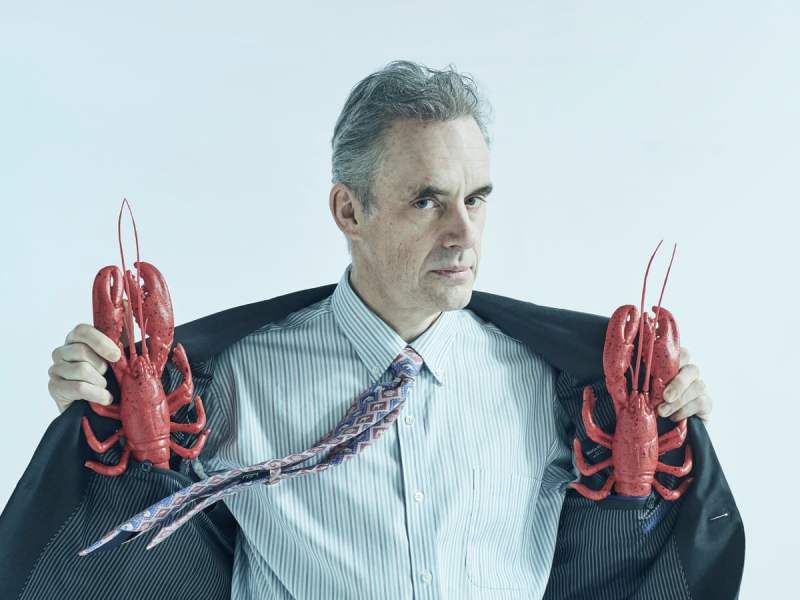
Jordan Peterson is one of the most popular psychologist of our time. You can hate him or love him but his book, “12 rules for life” has some interesting stuff.

During the first pages of chapter one, Peterson begins writing about our similarities with lobsters, birds and dolphins. Although he quoted the primatologist, Frans De Waal (page 10). I must admit that I disliked Peterson’s fascination with these crustaceous. Why lobsters? I asked myself. If we already know that we can learn a lot about our behaviour from other primates such as Chimpanzees and Bonobos why waste time comparing Homo Sapiens’ with something like a lobster? I tried to be more tolerant with the idea that we can learn something from dolphins because they are mammals like us and they are extremely intelligent, like most of us, but I did not want to accept the fact that we can learn a lot from other non human animals such as birds …. or lobsters!

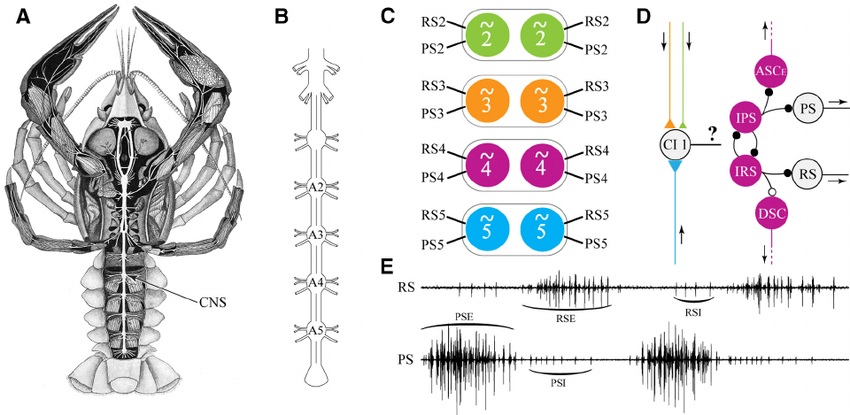
How naive I was! but it is part of the process of learning. The reason why Peterson prefers to use lobsters as a way to explain humans’ hierarchies it is because their nervous systems are comparatively simple, with large, easily observable neurons. Because of this, scientist have been able to map the neural circuitry of lobsters very accurately. This has helped us understand the structure and function of the brain and behaviour of more complex animals, including human beings (Peterson, 2018).
Example of the organization of the neural circuits that control crayfish (a crustaceous related to lobsters) swimmerets. Diagram by Smarandache-Wellmann, Weller & Mulloney.
In fact, lobsters are not the only animals in the ocean with simple nervous systems. According to Jaak Panksepp professor emeritus in Psychobiology, there is a sea slug called California sea hare (Aplysia Californica) that fascinates scientists because, just like lobsters, it has a simple nervous system of about 20,000 nerve cells and a set of defensive reflexes that have been used effectively to study the neuronal basis of learning, especially classical conditioning.
Image of a Aplysia Californica. Credit to In-depth Images California.
For example, touching the siphon or gill leads to withdrawal of these organs, but this response habituates rapidly. If, however, this type of conditioned stimulus (touch) is paired with electric shock to the tail, the animal develops a conditioned learning has been most extensively studied in this creature, there has been some success in training these animals to also exhibit instrumental learning (Panksepp, 2005).
Why this is relevant to psychology? It is really necessary to study other non human animals in order to understand more about humans’ psyche? Well, I had those questions when I started to read Peterson’s book and was in other book “Our Inner Ape” by Frans de Waal that I finally understood the importance of study other animals in order to understand more about ourselves.
Primatologist Frans De Waal.
De Waal, famous Dutch primatologist who worked in the department of Psychology at Emory University in Atlanta, explains why we can learn not only from other primates but from birds and fish too: “Birds and fish have always held and appeal for me, so that even now my offices and labs have fish tanks, which students are sometimes asked to look after. They seek me out to learn about primates, and the I spring the fish on them!”
De Waal continues explaining the importance of watch the behaviour of other animals in order to understand humans’ conduct and not only learn exclusively about human beings “Having been trained in anthropocentric disciplines, such as psychology and anthropology, they laugh (his students) at the possibility that slippery animals at the bottom of the evolutionary scale could be of interest. But they have much to teach us. And as for every creature on earth, the urge to reproduce is at the core of their existence (De Waal, 2005).
Overall, De Waal and Panksepp arguments helped me to understand more Jordan Peterson’s attitude towards lobsters but at the same time to realise that a lot of people in psychology (myself included) had an anthropocentric education at University, where a lot of subjects are about the study of human beings exclusively without considering our similarities with other animals. Certainly, it is fundamental to analyze the scientific studies in humans’ and the investigations about human brain.
However, it is also important to encourage students in psychology to analyze deeply the behaviour and neurological systems in other animals as well. In addition, we should not only focus our attention in primates because different species in animal kingdom have a lot to teach us about our own behaviour and what we can learn from them in order to have healthier individuals in our societies. Without mention the benefits to be closer to nature and feel more empathy and compassion towards other animals.





























 Sapiens Lara