
Book review: Why Buddhism is True by Robert Wright.

When people asked me which book has impacted me the most, I didn’t know how to respond because many books are meaningful to me and I didn’t want to pick one in particular. However, the content of the book ‘Why Buddhism is true’ by American writer Robert Wright has been so positive in my life that now I do not hesitate to respond that Wright’s book has been one of the most incredible books I’ve read. 
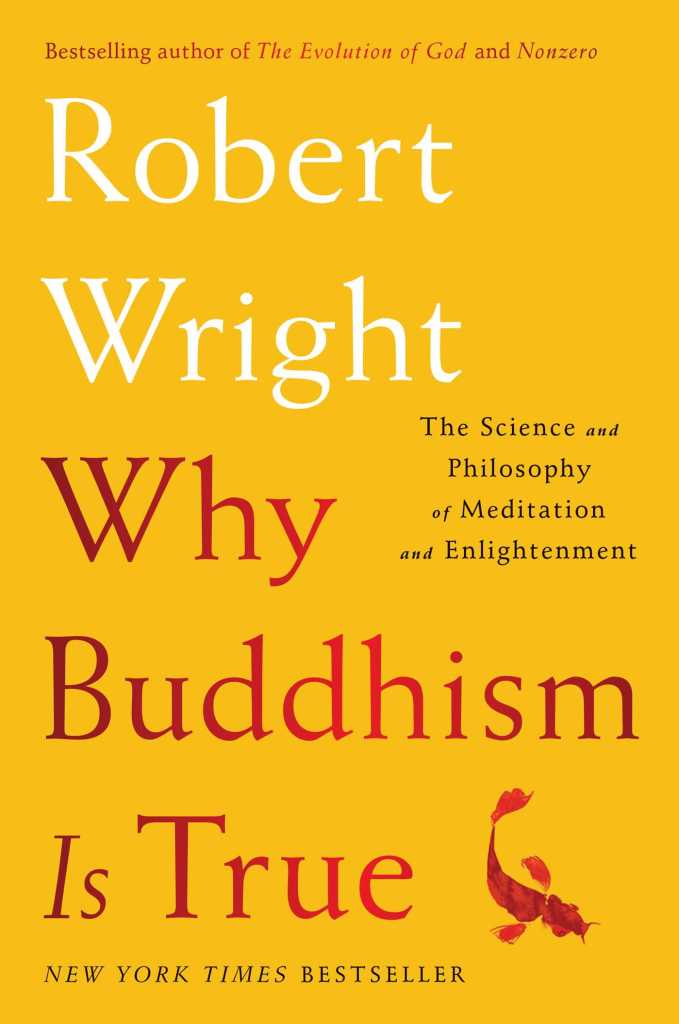
I learned about Robert Wright’s work in Christopher Ryan’s books. Ryan is the co-author of ‘Sex at dawn’ and author of ‘Civilized to death’, where he wrote about one of Wright’s most famous books ‘The moral animal’. Intrigued by the title, I got my copy and since then I became a huge admirer of Wright’s literature.  After I finished ‘The moral animal’, I found out that he had another popular book called ‘Why Buddhism is true’ and as I was starting to become more interested in Buddhism, I decided to also read that one.    

It turned out to be a fascinating book about Buddhism, meditation, and Enlightenment. I’m so grateful to Robert Wright’s talent that decided to write this brief review to motivate anyone interested in discovering the benefits of Vipassana meditation and learn the basics of Buddhism, to get a copy of this inspirational book. 

What makes this book fascinating?

Why Buddhism is true was published in 2017 and the first Simon & Schuster paperback edition was published in May 2018. The author, Robert Wright, is an American journalist who writes about science, religion, history, and politics. As mentioned above, he is also the author of other books such as ‘The moral animal’ (1994), Nonzero: The logic of human destiny (1999), and ‘Evolution of God’ (2009).  

Photo by Saffu.


The book begins with a fascinating analysis of how natural selection has shaped our brains in thousands of years of evolution to behave in certain ways. I liked how he used a famous American film as an analogy to explain the influence of natural selection in our modern lives. Then, Wright writes about the perspectives of Buddhism and modern psychology on human emotions. One of the parts that I most enjoyed was a revolutionary theory about the human brain and how he brilliantly challenge the readers to change our perspective about the idea of the ‘self’.

Another meaningful part of the book was the anecdotes of the author when he met experienced teachers in Buddhism, and how they show us that despite the centuries, the wisdom of the Buddha remains as a path to achieve inner peace. 

Photo by Sarah Ball.

 Personally, this book was important for me because it was my official contact with Buddhism’s history, concepts, and philosophy. The author brightly explains the basics of Buddhism for an audience without or with minimum experience in this religion and philosophical tradition. Finally, I appreciate that the author decided to share his personal experiences meditating, which reflects that he is not only a scholar of meditation but also includes it in his personal life.  

To conclude, ‘Why Buddhism is true’ is a highly recommended reading for anyone who wants to start learning about Buddhism and meditation. The book will also challenge you to reconsider the way you see your mind and how you see the world itself.  

References.

Featured image by RKTKN on Unsplash

Fantasize is beneficial, as long as you know that you’re fantasizing.

In the past, some psychologists saw fantasies as something negative. Something that all patients should avoid in order to have a balanced life. However, today we know that fantasies could be beneficial for your mental health as long as you know that you are fantasizing. This sounds complex but it’s easy to understand. Fantasies (not only sexual but all kind of fictional scenarios in our mind) are essential to take a break from reality and relax from the stress of our normal life. Nevertheless, the key is to understand that those fantasies are just creations of our brain that can help us to relax but we shouldn’t spend too much time fantasizing and stop working in our personal aims in the real world.

The benefits of fantasize.

Portrait of Esther Perel, photo by Karen Harms.

Esther Perel, therapist and author of the best seller “Mating in captivity”, wrote about the new attitude in psychotherapy towards fantasies, she wrote “In my own practice, I’ve come to view fantasy as a valuable imaginative resource, whether it is cultivated by individuals or jointly by couples. The ability to go anywhere in our imagination is a pure expression of individual freedom. It is a creative force that can help us transcend reality. By giving us an occasional escape from a relationship, it serves as a powerful antidote to loss of libido within the relationship. Simply put, love and tenderness are enriched by the spice of imagination” (Perel, 2007).

Perel’s advice is useful not only to understand the benefits of sexual fantasies in relationships but to appreciate the power of our mind to create scenarios that can transcend reality. Fantasies are not only useful to understand our psyche but also to take a little break from reality.

Probably you learnt some meditation techniques where with your eyes closed and deep breaths you needed to imagine that you were walking in a forest or at the beach in order to feel more relaxed. Some people fantasize about other things, like visiting a magical land from a novel or videogame, or dancing under the stars with a famous and good looking actor. Regardless of what fantasy is your predilect, when we use these techniques, we use the power of our mind to be in places where we can feel safe and happier, at least for a couple of minutes. And then we come back to the real world feeling better.

The importance is understand where reality begins.

The biggest fear for a lot of people towards fantasies was that these could lead to permanently lose contact with reality. It is an understandable fear, however we know now that this could be avoidable if we are aware that our fantasies are just briefs escapes from reality and not the real life. A good method to avoid this issue is increase our body awareness. A term which means be aware of our body sensations with the world. Walks in the nature, breathing, yoga, exercise, cold showers are great ways to stay in contact with reality and the present. To conclude, we need to remember that fantasies are not negative if we are intelligent and we always return to the real world by the high sensitivity of our organic bodies.

References

Perel, E. (2007) Mating in Captivity, Unlocking Erotic Intelligence. 1st ed. Harper Collins. New York.

An Evening with Esther Perel (2020) [Online] https://artsandlectures.ucsb.edu/Details.aspx?PerfNum=4136