
Disclaimer: This article is for educational purposes only and is not a substitute for professional guidance.

Dogs and humans created a special bond 15,000 years ago, although some scientists believe that dogs’ domestication began between 20,000 and 40,000 years ago (Briggs, 2017). There’s no doubt that we have a special relationship with this species, and this relationship is so meaningful that sometimes we like to associate dog companionship with low levels of loneliness. But, do we have evidence that dog companionship helps to beat loneliness? First, let’s take a look at the concept of loneliness…
Loneliness is an involuntary separation, rejection, or abandonment by other humans (Cherry, 2022). This state of mind can produce different health issues such as cardiovascular disease, poor quality of sleep, and decrease viral immunity (Carlton, 2019). Sadly, loneliness became a popular topic during the pandemic of Covid-19, and because of this, more mental health practitioners are looking for different strategies to mitigate this problem. In this article, we’re going to learn from different publications to discover if having a dog can protect us against loneliness.
The importance of Human Social Support.

In one study published in Anthrozoos, the journal of the International Society for Anthrozoology, researchers Timothy A. Pychyl and Nikolina M. Duvall Antonacopoulus from Carleton University in Ottawa, Canada, analyzed the results of 132 pet owners and non-pet owners who completed an online survey about human social support, emotional attachment to pets, loneliness and depression. Contrary to the popular belief, their results show that pet owners and non-pet owners living alone didn’t have significantly different levels of loneliness (Antonacopoulus & Pychyl, 2010). However, they also found that dog owners with high levels of human social support were less lonely than non-owners with high levels of social support. These results demonstrate that owning a dog is an additional source of emotional support and also that meaningful human interaction is fundamental to beat loneliness (Duvall Antonacopoulus & Pychyl, 2010).
Years later, in 2017, Duvall Antonacopoulus published a longitudinal study about the changes in loneliness in people owning a dog over a period of 8 months. The researcher had two groups, the first group of 31 individuals who got a dog, and the second group of 35 non-dog owners. Duvall Antonacopoulus found out that the participants who had a dog were less lonely at 8 months than the other group. Primarily, because of the affection that the dog provides and for having the responsibility to look after another living being (Duvall Antonacopoulus, 2017).
Dog companionship during the pandemic.
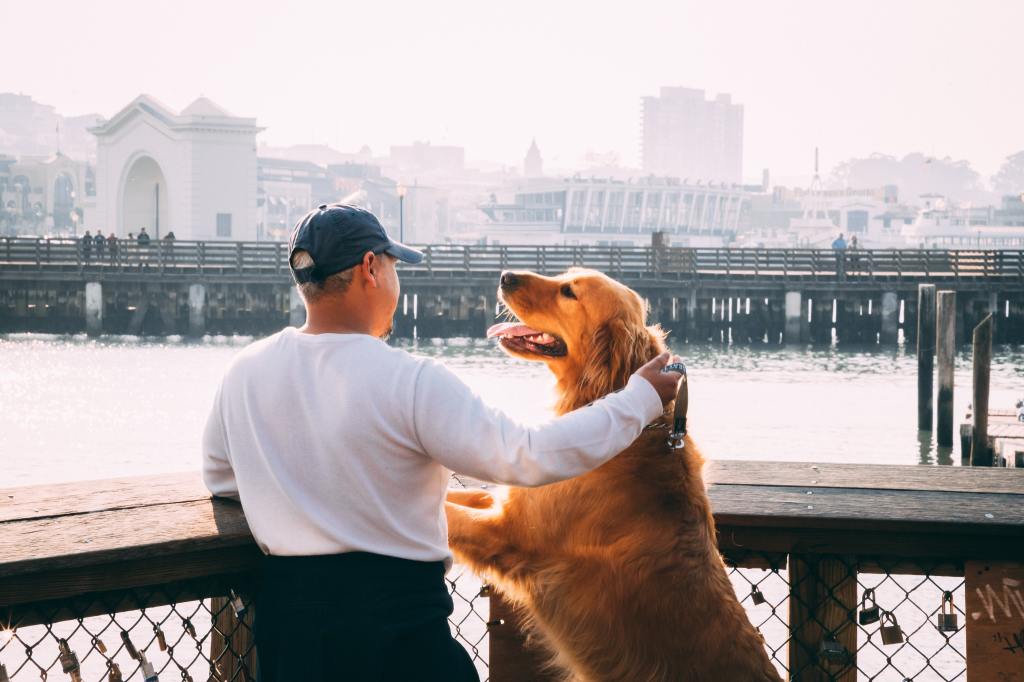
As mentioned above, loneliness became a common phenomenon in different countries, and this situation made different researchers investigate the benefits of owning a pet. For example, Oliva and Johnson (2020) from Monash University in Melbourne, made a study to know the experience of Australians living alone with and without a dog or a cat during the lockdowns due to Covid-19. Three hundred and eighty-four individuals answered an online survey about loneliness, mindfulness, and mood. The researchers discovered that dog owners declared that having a dog made isolation easier and that dog ownership significantly protects against loneliness. Another benefit that was found during this study, was that dogs encourage their humans to go outside for a walk and also that having a dog can make people socialize with other dog owners (Oliva & Johnson, 2020).
Loneliness and the elderly.

The elderly are vulnerable to social isolation and loneliness due to different factors such as the death of their spouse and friends, separation, and retirement (NHS, 2018). Because of this, researchers in different parts of the world want to know the benefits of owning a pet for this population. Hajek and Koning (2019) from University Medical Center Hamburg-Eppendorf in Germany, wanted to identify if cat owners, dog owners, and people without pets over 65 years old and without a partner, differ in terms of loneliness and social isolation. They evaluated 1,160 individuals of which 63 owned one or more dogs. They discovered that dog owners were less socially isolated than individuals without pets. Also that men dog owners had fewer depressive symptoms than men without pets (Hajek & Koning, 2019).
Conclusion.
We can see that different studies support the argument that dog companionship can protect people from loneliness. Nevertheless, the purpose of this article is not to promote the idea that a person suffering loneliness should get a dog as soon as possible. Not only because having a dog is a tremendous responsibility, but also because each person is different, and we always need to analyze the individual needs and background of the person. At the same time, we need to remember that is important to have meaningful relationships with members of our own species. The results from two of the studies mentioned above show the importance of human support and dogs can help us to connect with other people when we are outside walking with them.
Finally, as Antonacopoulos (2017) mentioned, sadly there is still a stigma toward loneliness, and because of this, some participants in their study hesitated to admit that they were lonely. I think we should start to talk and write more openly about this state of mind so we can get rid of this stigma, and show people that is fine to talk with a professional when they feel lonely so they can have a more meaningful life.

References.
Briggs, H. (2017, July 19). How did dogs become our best friends? New evidence. BBC News. https://www.bbc.com/news/science-environment-40638584
Carlton, K. (2019, February 13). What is loneliness? UChicagoMedicine. https://www.uchicagomedicine.org/forefront/health-and-wellness-articles/what-is-loneliness
Cherry, K. (2022, May 24). Loneliness: Causes and Health consequences. Very Well Mind. https://www.verywellmind.com/loneliness-causes-effects-and-treatments-2795749
Duvall Antonacopoulus, N.M, & Pychyl, T.A. (2010). An examination of the potential role of pet ownership, human social support and pet attachment in the Psychological Health of Individuals living alone. Anthrozoos, 23(1), 37-54. https://doi.org/10.2752/175303710X12627079939143
Duvall Antonacopoulus, N.M. (2017). A longitudinal study of the relation between acquiring a dog a loneliness. Society & Animals, 25(4), 319-340. doi:10.1163/15685306-12341449
Hajek, A. & Koning, H.H. (2020). How do cat owners and individuals without pets differ in terms in terms of psychosocial outcomes among individuals in old age without a partner? Aging & Mental Health, 24(10), 1613-1619. 10.1080/13607863.2019.1647137
NHS. (2018, September 4). Loneliness in older people. NHS. https://www.nhs.uk/mental-health/feelings-symptoms-behaviours/feelings-and-symptoms/loneliness-in-older-people/
Oliva, J.L. & Johnston, K.L. (2020). Puppy love in the time of corona: Dog ownership protects against loneliness for those living alone during the COVID-19 lockdown. International Journal of Social Psychiatry, 67(3), 232-242. https://doi.org/10.1177/0020764020944195
Featured Image by Ekaterina Novitskaya on Unsplash
 Sapiens Lara