
The contributions to Psychology from scientific fields such as Primatology are fundamental to understand more about our behaviour as human beings. Aggressiveness, mating, sexual promiscuity and social hierarchies are the most popular topics for students and professionals in Psychology interested in learn from Primatology.
However, every day we do other common activities that are usual as well in bonobos and chimpanzees. In this article, we are going to study the investigations of the primatologist Frans De Waal and discover some similarities that we share with other primates and how close we are with them.
French Kiss or Bonobo Kiss?
The French kiss is normal in humans during sexual intercourse and to show desire, trust and love for a partner. This form of kiss is common in other primates too, such as chimpanzees and bonobos. In fact, the French Kiss is the bonobo’s most recognizable, humanlike erotic act.
Whereas for chimpanzees a kiss is friendly rather than sexual. The tongue kiss is an act of total trust: the tongue is one of our most sensitive organs, and the mouth is the body cavity that can do it the quickest harm. The act permits us to savor another. But at the same time we exchange saliva, bacteria, viruses and food.(De Waal, 2005, p.90).

Personal Grooming.
You take a shower, put your clothes on, maybe some make up and perfume. Before leave the house, you need to fix your husband’s tie and your kids’ hair. Now everybody is ready to attend your cousin’s wedding! Grooming is a normal activity for humans and an expression of love for ourselves and our beloved ones, and with other primates is not different.
Just as De Waal said “Grooming is the social cement of any primate society” and humans are not the exception. Perhaps we don’t spend hours cleaning the head of our children or friends as chimpanzees do but the simple act of grooming is another daily activity that we share with other primates.
Sharing food.
We share turkey in Thanksgiving day and Christmas, we do BBQs to share burgers and steak with our friends and some cultures sacrifice a lamb for special occasions like weddings. These activities are not exclusively human as share food, meat in particular, is also pretty common among chimpanzees and capuchin monkeys. (De Waal, 2005, p.206).
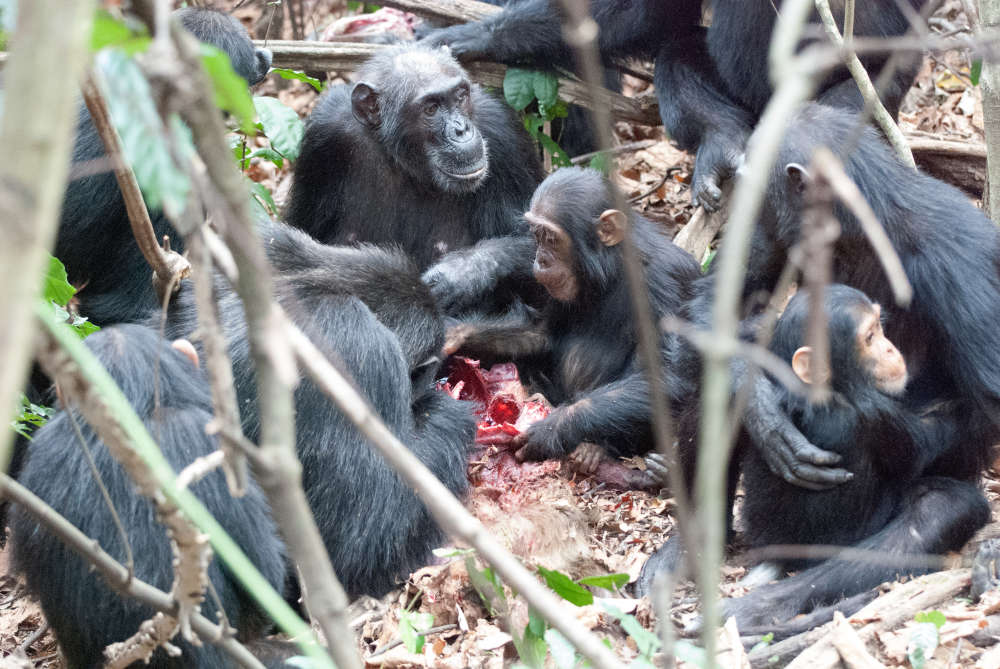
In the wild, these primates chase monkeys until they capture one and they tear it apart so that everyone gets a piece. Interestingly, food sharing is also possible with vegetarian meals. Frans De Waal observed that when he and his team fed chimpanzees at the zoo, normally watermelons or a tight bundle of branches with leaves, the primates burst out in a celebration during which they kiss and embrace each other.
So the next time that you are sharing food with your loved ones, have in mind that you are doing an activity that is normal for these primates and also is a heritage from our ancestors who were experts on hunting.
Reconciliation.
According to Cambridge Dictionary, reconciliation is a situation in which two people or groups of people become friendly again after they have argued (Cambridge, n/d). Humans are not the only creatures capable of this action, as every year are more proofs that reconciliation exist also in other primates. Frans de Waal has a fascinating story about an example of reconciliation between chimpanzees:
I’ll never forget one particular winter day at the Arnhem Zoo (Netherlands). The entire chimpanzee colony was locked indoors, out of the cold. In the course of a charging display, I watched the alpha male attack a female, which caused great commotion as other apes came to her defense. The group calmed down, but an unusual silence followed, as if everyone was waiting for something. It lasted a couple of minutes. Then, unexpectedly, the entire colony burst out hooting, and one male rhythmically stamped on the meal drums stacked in the corner of the hall. In the midst of all the pandemonium, at the center of attention, two chimps kissed and embraced. I reflected on this sequence for hours before I realized that the two embracing apes had been the male and female from the original row (De Waal, 2005, p 150).
There is something important to remember, just as chimpanzees, bonobos and capuchin monkeys, humans are social primates, hence social interactions are fundamental to our species. That is the reason why reconciliation for these primates is really important to maintain peace within the group. We always believed that reconciliation was an authentic human action but now we know that is a normal strategy to resolve conflict among other primates too.
Empathy.

This is connected and necessary for reconciliation. The Russian psychologist Nadezhda Ladygina-Kohts who raised a young chimpanzee named Yoni during the early-twentieth century, discovered the existence of empathy in Yoni when she realised that the only way to get him off the roof of her house was to appeal to his concern for her:
“If I pretend to be crying, close my eyes, and weep, Yoni immediately stops his plays or any other activities, quickly runs over to me, all excited and shagged, from the most remote places in the house, such as the roof or the ceiling of his cage, from where I could not drive him down despite my persistent calls and entreaties. He hastily runs around me, as if looking for the offender, looking at my face, he tenderly takes my chin in his palm, lightly touches my face with his finger, as though trying to understand what is happening” (De Waal, 2005, p.184).
Basically, empathy is the ability to be affected by the state of another individual or creature. One of the reasons that a lot of scientists considered empathy as an exclusive human skill was because was assumed that empathy requires language. However, Carolyn Zahn-Waxler, who is one of the pioneers of empathy research in children, had discovered that empathy develops well before language. This is relevant for animal research and to understand that other mammals are capable to feel empathy as well.
For instance, Carolyn’s research team discovered that household pets, like dogs or cats, were as upset as children by distress-faking family members. The animals hovered over them, putting their heads in their laps with what looked like concern. Judge by the same standard as the children, the pets exhibited empathy as well. Such behaviour is even more striking in apes, specifically chimps. De Waal argues that it’s not unusual for a climbing youngster to fall out of a tree and scream. It will immediately be surrounded by others who hold and cradle it. In addition, if an adult chimpanzee loses a fight with a rival and sits screaming alone in a tree, others will climb toward him to touch and calm him (De Waal, 2005, p.183).
Therefore, the investigations of Ladygina-Kohts, Zahn-Waxler and De Waal, make us understand that spoken language is not necessary to have empathy. Just ask parents how they feel when they hear their babies crying. They do not know how to articulate words yet, but their weeping is enough to make adults empathize with infant’s distress. Additionally, adults can feel empathy for someone without hearing words too. A man feels worry when he hears his girlfriend sobbing and vice vice versa.
Although it’s not a real situation, but we can observe an useful example of empathy without spoken language between humans on the episode “Back from Vacation” from the famous American sitcom “The Office US”. At the minute 14:53, the secretary Pam Beesly is crying alone in the halls of the building where she works. Suddenly, the salesman Dwight Schrute, who has a cold but strong personality, finds her co-worker sobbing painfully after she witnessed Jim Halpert and his girlfriend Karen make up after a fight.
Who did this to you? asked Dwight, even thought Pam did not say a word, Dwight knew that something was wrong and felt empathy for her, because her tears were enough to communicate her sorrow. The scene concludes with Dwight putting his hand gently on Pam’s shoulder while she continues crying (The Office, 2007).

The most interesting thing about this scene is that a human being (Dwight) felt empathy to see another person crying and he tries to comfort her even when he does not know the reason of Pam’s sadness. The wonderful use of this information is not only to finally accept that humans, primates and other animals can feel empathy without the use of words, but also to embrace that human beings do not need to speak the same language in order to show empathy towards others.
Conclusion.
Maybe is unfair to write in the same article about obvious animalistic actions like kissing, eating and grooming with something more complex like reconciliation and empathy. Nevertheless, this article’s intention is to show the reader our similarities with other primates not only to embrace our animal reality but also to remember that we are able to connect positively with other humans regardless our race and language.
And at the same time, that we need to continue investigating even deeper to understand more our behaviour and our evolutionary connection with the rest of animal kingdom to improve our relationship with the natural world. I highly recommend the book “Our Inner Ape” by the leading primatologist Frans De Waal to know more about this topic.
References.
De Waal, F. (2005) Our Inner Ape. Penguin Group.
Frans De Waal [Photograph]. https://www.ft.com/content/da283f36-3f9e-11e9-9bee-efab61506f44
Bonobos-Lola-Infants-kissing [Photograph] The Guardian, 2017. https://guardian.ng/life/love-and-relationships/why-do-we-kiss/attachment/bonobos-lola-infants-kissing/
Ian Gilby [Photograph] 2018, IFL Science. https://www.iflscience.com/plants-and-animals/some-chimps-have-a-very-gruesome-taste-in-food/
Cambridge Dictionary. (n/d) Reconciliation. Retrieved December 23, 2020 from: https://dictionary.cambridge.org/dictionary/english/reconciliation
Nadezhda Ladygina-Kohts and the chimpanzee Joni, [Photograph] 1914. Official Portal of the Moscow Mayor and Moscow Government. https://www.mos.ru/en/news/item/74118073/
Farino, J (Director) Spitzer, J (Writer). (2007, April 1) Back from Vacation. (Season 3, Episode 11) [The Office US Episode] In Silverman, B. Daniels, G. Gervais, R. Merchant, S. Klein, H. Lieberstein, P. Celotta, J. Schur, M. Zbornak, K. (Producers) NBC Universal.
 Sapiens Lara